Here's Why UnitedHealth Group (NYSE:UNH) Has A Meaningful Debt Burden
David Iben put it well when he said, 'Volatility is not a risk we care about. What we care about is avoiding the permanent loss of capital.' So it seems the smart money knows that debt – which is usually…
From the Equity Insider archive. This article dates from Dec 24, 2025 and is preserved as first published.
David Iben put it well when he said, ‘Volatility is not a risk we care about. What we care about is avoiding the permanent loss of capital.’ So it seems the smart money knows that debt – which is usually involved in bankruptcies – is a very important factor, when you assess how risky a company is. We note that UnitedHealth Group Incorporated (NYSE:UNH) does have debt on its balance sheet. But the more important question is: how much risk is that debt creating?
When Is Debt Dangerous?
Debt is a tool to help businesses grow, but if a business is incapable of paying off its lenders, then it exists at their mercy. Part and parcel of capitalism is the process of ‘creative destruction’ where failed businesses are mercilessly liquidated by their bankers. However, a more frequent (but still costly) occurrence is where a company must issue shares at bargain-basement prices, permanently diluting shareholders, just to shore up its balance sheet. Of course, debt can be an important tool in businesses, particularly capital heavy businesses. When we examine debt levels, we first consider both cash and debt levels, together.
How Much Debt Does UnitedHealth Group Carry?
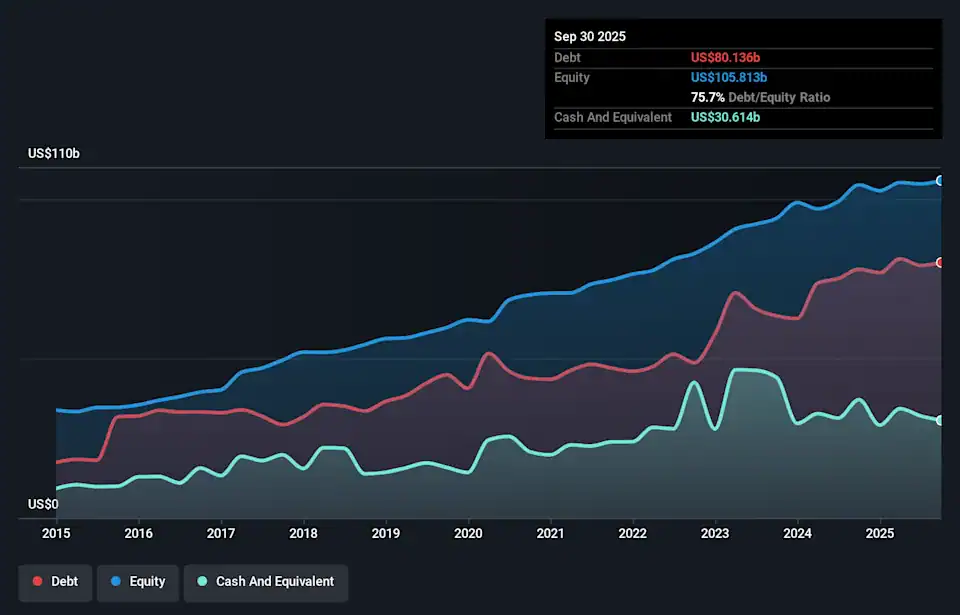
The chart below, which you can click on for greater detail, shows that UnitedHealth Group had US$80.1b in debt in September 2025; about the same as the year before. However, it also had US$30.6b in cash, and so its net debt is US$49.5b.
A Look At UnitedHealth Group’s Liabilities
The chart below, which you can click on for greater detail, shows that UnitedHealth Group had US$80.
The latest balance sheet data shows that UnitedHealth Group had liabilities of US$115.5b due within a year, and liabilities of US$93.9b falling due after that. On the other hand, it had cash of US$30.6b and US$55.4b worth of receivables due within a year. So its liabilities outweigh the sum of its cash and (near-term) receivables by US$123.4b.
While this might seem like a lot, it is not so bad since UnitedHealth Group has a huge market capitalization of US$296.6b, and so it could probably strengthen its balance sheet by raising capital if it needed to. However, it is still worthwhile taking a close look at its ability to pay off debt.
We measure a company’s debt load relative to its earnings power by looking at its net debt divided by its earnings before interest, tax, depreciation, and amortization (EBITDA) and by calculating how easily its earnings before interest and tax (EBIT) cover its interest expense (interest cover). This way, we consider both the absolute quantum of the debt, as well as the interest rates paid on it.
UnitedHealth Group has net debt worth 1.7 times EBITDA, which isn’t too much, but its interest cover looks a bit on the low side, with EBIT at only 6.5 times the interest expense. While that doesn’t worry us too much, it does suggest the interest payments are somewhat of a burden. On the other hand, UnitedHealth Group’s EBIT dived 18%, over the last year. We think hat kind of performance, if repeated frequently, could well lead to difficulties for the stock. The balance sheet is clearly the area to focus on when you are analysing debt. But it is future earnings, more than anything, that will determine UnitedHealth Group’s ability to maintain a healthy balance sheet going forward. So if you’re focused on the future you can check out this free report showing analyst profit forecasts.
Finally, while the tax-man may adore accounting profits, lenders only accept cold hard cash. So the logical step is to look at the proportion of that EBIT that is matched by actual free cash flow. During the last three years, UnitedHealth Group produced sturdy free cash flow equating to 63% of its EBIT, about what we’d expect. This free cash flow puts the company in a good position to pay down debt, when appropriate.