



AI is about to change healthcare. These 20 stocks are working on everything from early diagnostics to drug discovery. The best part – they are all under $10bn in marketcap – there is still time to get in early.
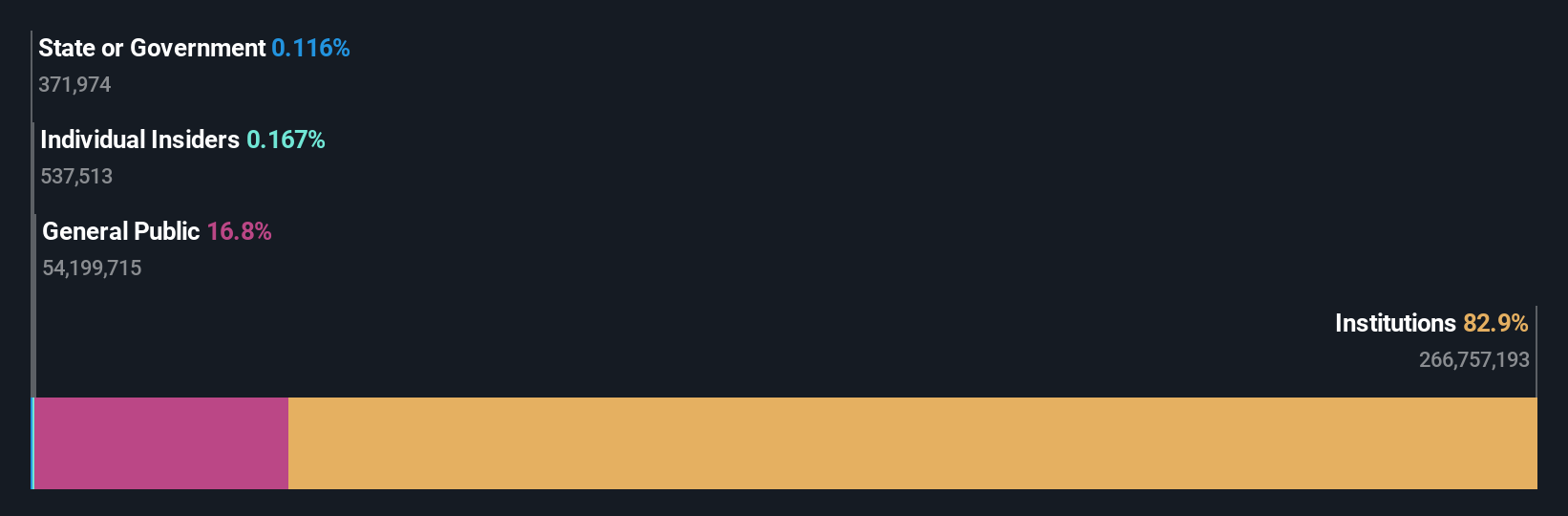
To get a sense of who is truly in control of WEC Energy Group, Inc. (NYSE:WEC), it is important to understand the ownership structure of the business. We can see that institutions own the lion’s share in the company with 83% ownership. That is, the group stands to benefit the most if the stock rises (or lose the most if there is a downturn).
Because institutional owners have a huge pool of resources and liquidity, their investing decisions tend to carry a great deal of weight, especially with individual investors. Hence, having a considerable amount of institutional money invested in a company is often regarded as a desirable trait.
In the chart below, we zoom in on the different ownership groups of WEC Energy Group.
What Does The Institutional Ownership Tell Us About WEC Energy Group?
Institutions typically measure themselves against a benchmark when reporting to their own investors, so they often become more enthusiastic about a stock once it’s included in a major index. We would expect most companies to have some institutions on the register, especially if they are growing.
We can see that WEC Energy Group does have institutional investors; and they hold a good portion of the company’s stock. This suggests some credibility amongst professional investors. But we can’t rely on that fact alone since institutions make bad investments sometimes, just like everyone does. If multiple institutions change their view on a stock at the same time, you could see the share price drop fast. It’s therefore worth looking at WEC Energy Group’s earnings history below. Of course, the future is what really matters.

Institutional investors own over 50% of the company, so together than can probably strongly influence board decisions. We note that hedge funds don’t have a meaningful investment in WEC Energy Group. The Vanguard Group, Inc. is currently the company’s largest shareholder with 12% of shares outstanding. With 9.3% and 6.4% of the shares outstanding respectively, BlackRock, Inc. and State Street Global Advisors, Inc. are the second and third largest shareholders.
A closer look at our ownership figures suggests that the top 18 shareholders have a combined ownership of 51% implying that no single shareholder has a majority.
Researching institutional ownership is a good way to gauge and filter a stock’s expected performance. The same can be achieved by studying analyst sentiments. There are a reasonable number of analysts covering the stock, so it might be useful to find out their aggregate view on the future.
Insider Ownership Of WEC Energy Group
While the precise definition of an insider can be subjective, almost everyone considers board members to be insiders. Management ultimately answers to the board. However, it is not uncommon for managers to be executive board members, especially if they are a founder or the CEO.
Most consider insider ownership a positive because it can indicate the board is well aligned with other shareholders. However, on some occasions too much power is concentrated within this group.
Our data suggests that insiders own under 1% of WEC Energy Group, Inc. in their own names. As it is a large company, we’d only expect insiders to own a small percentage of it. But it’s worth noting that they own US$58m worth of shares. In this sort of situation, it can be more interesting to see if those insiders have been buying or selling.
General Public Ownership
The general public, who are usually individual investors, hold a 17% stake in WEC Energy Group. This size of ownership, while considerable, may not be enough to change company policy if the decision is not in sync with other large shareholders.