

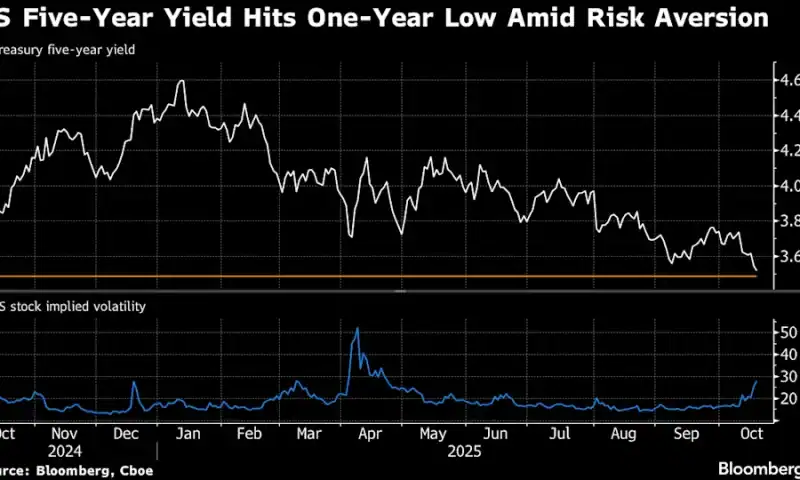
A rally in Treasuries driven by concerns around US regional bank credit exposures and resurgent trade tensions stalled after comments on China by US President Donald Trump stabilized the stock market.
Benchmark yields were higher by as much as five basis points after erasing declines. The reversal tracked an early rebound in US stocks after Fox Business televised part of an interview with Trump in which he said the high tariffs he has threatened to impose on China aren’t sustainable.
Reinforcing investment risk appetite, several economists said state-level data suggest that new claims for unemployment insurance benefits declined last week, a sign of labor-market strength. National data remain held up by the US government shutdown that began Oct. 1.
“The market’s pricing for growth expectations has continued to slip despite the absence of key data,” interest-rate strategists including Gennadiy Goldberg and Jan Nevruzi at TD Securities said in a report. “We refrain from chasing the move lower as we believe underlying economic data has not deteriorated sharply.”
The 10-year note’s yield fell back below 4% this week, prompting US rates strategists at JPMorgan Chase & Co. to scrap their tactical recommendation to be short, because of “the risk of a follow-through to lower yields.” A surge in open-interest in bullish options on 10-year notes has underscored that risk.
Earlier Friday, yields declined to the lowest levels in months, extending steep declines Thursday after two US regional banks disclosed problem loans, prompting investors globally to seek havens. Shares of those banks rebounded in trading Friday, further eroding haven demand.
European and UK government bonds took direction from Treasuries. German 10-year yields dropped as much as five basis points to 2.52%, the lowest level since June. Meanwhile, UK two- and 10-year yields fell as much as five basis points to 3.80% and 4.45% respectively.
The setback for US regional banks helped cement expectations for two more quarter-point interest rate cuts by the Federal Reserve this year, which had mounted over recent weeks as the US government shutdown threatened to further weaken the nation’s job market.
Traders boosted bets on US interest-rate cuts to price in as many as five quarter-point reductions by the end of next year, with around a 30% chance of a sixth.
Fed officials this week reinforced wagers on more policy easing. Governor Christopher Waller said Thursday that rates can continue to decline in quarter-point increments, while his counterpart Stephen Miran advocated a larger reduction.

“In the absence of official data, investors focused on negative news flow and increased bets on Fed easing,” Eugene Leow, senior rates strategist at DBS Bank Ltd., wrote in a note. “We maintain that US yields will have a downward bias in the near term, a trend that could turn more acute if sentiment worsens.”
Read more on the UST market: Basis Trade Helps Mask Who Owns $1.4 Trillion of Treasuries
Another source of bullish momentum in Treasuries, according to the JPMorgan strategists, is the possibility that the Treasury Department’s quarter primary dealer survey questions to be released at noon in Washington “could feature a question on the demand for longer-duration Treasuries.”
“Market participants may construe this as a sign Treasury is considering cuts to longer-maturity auction sizes at the next refunding, potentially adding more momentum to the latest rally,” they wrote. They consider that outcome “extremely unlikely” based on the department’s recent guidance, however, and anticipate re-setting a bearish position at lower yield levels.