

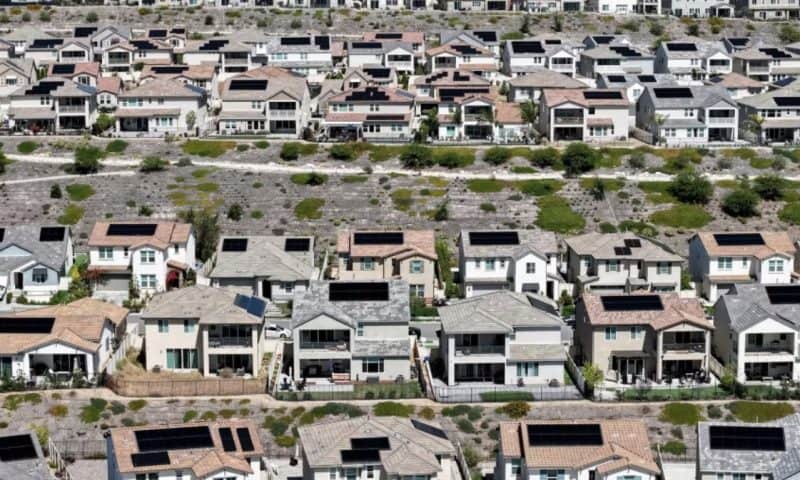
The war with Iran has roiled Wall Street, driving up the cost of a mortgage along with auto and credit card loans, making everyday life more expensive for Americans.
Mortgage rates climbed for five straight weeks after the war began, but ticked down this week to 6.37% for the average 30-year fixed mortgage, according to Freddie Mac.
Just weeks ago, borrowing was far cheaper. In late February, just two days before the United States and Israel began joint strikes on Iran, the average 30-year fixed mortgage rate fell to 5.98%, dipping below 6% for the first time in more than three years.
Different consumer borrowing rates track different metrics. Some loans, for example, track US Treasuries; those yields are up now as investors worry about inflation.
Other borrowing is pegged to the interest rate set by the Federal Reserve. The Fed has been in a holding pattern on rates lately, a stance that’s likely to continue if rising energy costs reignite inflation.
Mortgage rates tend to track the 10-year US Treasury yield, which has climbed across the past month as investors have reckoned with the surge in oil prices, nerves about inflation and the potential for increased government spending to fund the war. Yields rise when bond prices fall.
The 10-year US Treasury yield rose from below 4% at the end of February to as high as 4.48% in March before trading around 4.3% this week. That yield is one of the most significant interest rates for the economy, strongly influencing mortgage rates and a range of other borrowing costs for everyday Americans, as well as businesses and the US government.
“Investors are now coming to grips with the likelihood of a prolonged war with Iran and what that would mean for the economy,” said Jeffrey Roach, chief economist at LPL Financial. “The longer global oil supply is crimped, the more likely inflation pressures will increase.”
Here’s how the war is making Americans pay more for credit:
Mortgage rates
Even with this week’s drop in mortgage rates, a typical homebuyer who locked in a rate just a few weeks ago would save tens of thousands of dollars over the life of a loan compared with someone taking out a mortgage today.
Take a $500,000 home. Assuming a 20% downpayment, a buyer who locked in a 30-year fixed mortgage in February, when the average mortgage rate was 5.98%, would be paying about $28,700 per year in principal and interest. At this week’s average mortgage rate of 6.37%, the yearly payment on that same loan would be $29,931. While that may not seem like much, the difference in yearly payments adds up: Over the life of the 30-year loan, today’s homebuyer would pay more than $36,000 than a buyer in February.
“Borrowers are not going to like that,” said Larry White, professor of economics at NYU Stern. “That adds a non-trivial amount to their monthly mortgage payment.”
But despite the rise in rates over the past few weeks, mortgage rates are still lower than at this time last year, when the 30-year average fixed mortgage rate was 6.62%.
Auto loans
Rising Treasury yields could impact other borrowing rates, like auto loans, since the interest rate on a five-year auto loan tends to track short-term bond yields.
Five-year and two-year Treasury yields soared in March and are hovering at their highest levels since August.
Average rates on five-year auto loans have barely budged during the war, according to Bankrate data, but higher-for-longer bond yields could keep auto rates elevated after they had climbed higher in recent years.
“We’re probably looking at a plateau,” said Stephen Kates, financial analyst at Bankrate.
“The biggest question for borrowing rates, and this is true of mortgages, which obviously have gone up substantially, is the duration of this conflict,” Kates said. “How long this goes on and the uncertainty it brings is going to have more of an impact on borrowing rates than anything.”
The average five-year auto loan rate hovers around 7%, according to Bankrate. For a borrower who takes out a five-year $30,000 loan at a 7% rate, it translates into monthly payments of roughly $594.
That higher cost comes when Americans are also facing higher gas prices. And car prices have climbed, too.
“Financing auto loans will be more costly for longer and so the affordability of a new car (which are already quite expensive by historical standards), will become even more so,” Derek Stimel, associate professor of teaching economics at the University of California at Davis, said in an email.
Credit cards
Many interest rates across the economy, like credit card rates, tend to track the Fed’s benchmark interest rate. The rates on credit cards also include a (usually) large margin.
Credit card rates soared in 2022 and 2023, and the average annual rate remains above 19%.
Credit card rates have stayed elevated despite the Fed cutting rates a few times across 2024 and 2025. The war with Iran has not directly pushed those card rates higher, but it’s unlikely they’ll come down anytime soon.
Traders have dialed back expectations for the Fed to cut interest rates this year, with markets now anticipating the central bank will hold rates steady in the coming months.
“If the Fed keeps rates where they are and doesn’t cut, then credit card rates will remain elevated, making it more difficult to afford more routine purchases such as groceries or other spending that ends up in credit card balances,” Stimel said.