

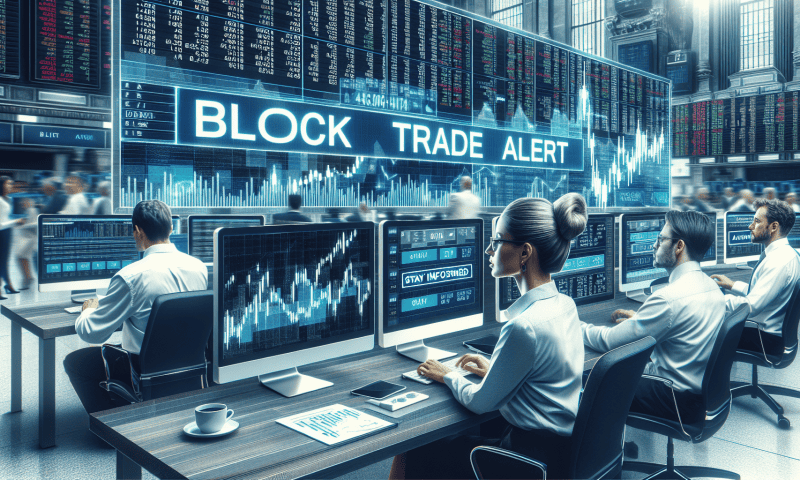
When institutional investors make their moves, the market trembles. These massive transactions, often worth millions of dollars, can signal significant shifts in market sentiment and provide savvy traders with invaluable insights into where smart money is flowing. This is where block trade alert systems become indispensable tools for active traders seeking to capitalize on institutional activity.
A block trade alert represents notifications about large-volume transactions that typically involve at least 10,000 shares or $200,000 in value, though the exact thresholds can vary depending on the platform and asset class. These alerts capture the footprints of hedge funds, pension funds, mutual funds, and other institutional players as they execute substantial positions that can move markets.
The power of monitoring these large transactions lies in their predictive nature. When a major institution commits significant capital to a position, it often reflects extensive research, insider knowledge of company fundamentals, or broader market trends that retail traders might not yet recognize. By tracking these movements through sophisticated alert systems, individual traders can potentially align their strategies with institutional flow rather than fighting against it.
Modern block trade alert platforms leverage real-time market data feeds to identify unusual trading activity across multiple exchanges simultaneously. These systems analyze volume spikes, price movements, and order flow patterns to distinguish between routine institutional trading and potentially significant market-moving transactions. The most advanced platforms can even identify when institutions are attempting to disguise their trading through techniques like iceberg orders or algorithmic execution spread across extended time periods.
For active traders, the timing element of block trade alert notifications proves crucial. Markets can react swiftly to large institutional moves, sometimes within minutes of execution. Traders who receive alerts quickly can position themselves to benefit from the momentum these large trades often generate. Whether it’s a massive equity purchase that signals bullish sentiment or a significant options position that suggests directional expectations, these alerts provide actionable intelligence that can inform trading decisions.
The interpretation of block trade data requires understanding the context surrounding each transaction. A large purchase by a known value investor carries different implications than a similar-sized trade by a momentum-focused hedge fund. Similarly, the sector, market conditions, and recent company developments all influence how traders should respond to block trade alert information. Successful traders develop pattern recognition skills to identify which types of institutional activity historically correlate with profitable trading opportunities.
Risk management becomes particularly important when trading based on institutional activity signals. While following smart money can be profitable, institutional traders occasionally make mistakes or may be executing trades for reasons unrelated to directional market views, such as portfolio rebalancing or risk management requirements. Effective block trade alert utilization involves combining this intelligence with other technical and fundamental analysis tools rather than relying solely on institutional flow data.
The democratization of block trade monitoring through accessible alert systems has leveled the playing field between retail and institutional traders to some degree. Previously, this type of market intelligence was primarily available to professional traders with expensive Bloomberg terminals or direct market access. Today’s retail traders can access similar insights through various platforms and services, though the quality and speed of data can vary significantly between providers.
As markets continue evolving and institutional trading strategies become more sophisticated, block trade alert systems must adapt accordingly. Machine learning algorithms now help identify subtle patterns in institutional behavior, while integration with social media sentiment and news flow provides additional context for interpreting large trades. The most successful traders using these systems continuously refine their approach based on changing market dynamics and institutional behavior patterns.
For serious active traders, incorporating block trade alert monitoring into their market analysis toolkit represents a strategic advantage in today’s complex financial markets. By understanding how institutional money flows and positioning themselves accordingly, traders can potentially improve their success rates while gaining deeper insights into market mechanics that drive price movements across all asset classes.