

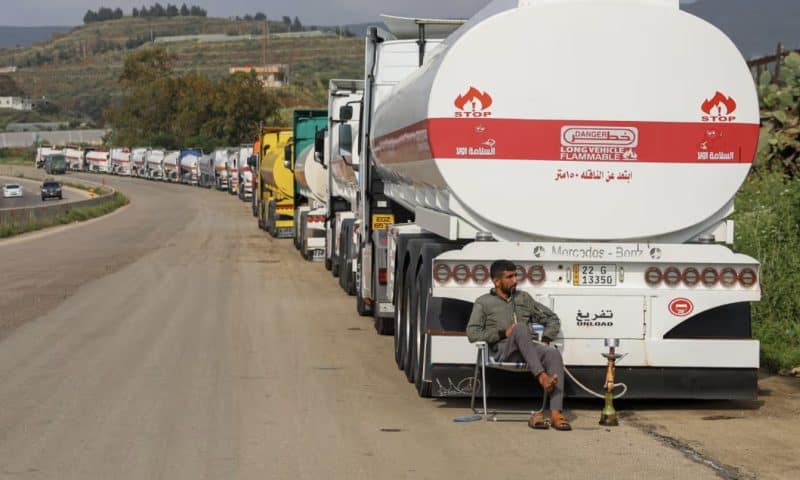
The price of oil jumped and stocks fell slightly Monday as traders digested renewed tensions between the U.S. and Iran over the critical Strait of Hormuz.
U.S. crude oil closed up more 6.8%, to $89.61 per barrel, and international Brent crude oil rose 5.6%, to $95.48 per barrel.
After opening lower by about a half of a percent, the S&P 500 ended the day down just 0.2%. The Nasdaq Composite fell 0.3%, after earlier tumbling as much as 1%, and the Dow Jones Industrial Average ended flat. The Russell 2000 index rose 0.6%.
Wholesale gas prices also rose by 4% and heating oil futures, which are a proxy for jet fuel prices, spiked 5%. Natural gas rose 1%.
The moves add to weeks of dramatic ups and downs, as investors try to strategize amid the almost daily swings between war and peace. While major U.S. stock indexes had recently recovered all the losses they incurred since the war began, oil prices have remained elevated, costing consumers more at the gas pump and pushing inflation higher.
The average price per gallon of unleaded gas was $4.04 per gallon Monday, according to AAA.
The day’s market moves began with optimism that an extended ceasefire deal was close, after a senior Iranian official told Reuters the nation was “positively” reviewing possible participation in peace talks with the U.S.
But Trump took the bounce out of U.S. indexes a little later in the day when he told Bloomberg News it was “highly unlikely” he would extend the two-week ceasefire, which he said would expire on “Wednesday evening, Washington time.”
Trump also told the outlet, “I’m not opening [the Strait of Hormuz] until a deal is signed.”
The crucial transit point off Iran typically sees more that 20% of the world’s oil supply pass through it on a daily basis — but has been effectively closed since the beginning of March.
On Monday, just three ships were recorded crossing the waterway, a fraction of the hundreds of ships per day that would typically cross before the war.
Opening the strait and returning to a system which guarantees oil and liquefied natural gas can pass through to global markets is the primary focus of investors, who are looking for any signs this outcome is closer.
Iran had declared the strait open for commercial vessels Friday — sending stock indexes soaring and oil prices plummeting 11%. But officials walked that back over the weekend, accusing the U.S. of only “partially implementing the ceasefire” by maintaining its own naval blockade of the strait.
When Iran announced the strait was closed again, dozens of commercial ships that had been prepared to transit the strait turned back. They remained trapped Monday in the Persian Gulf.
Shipping giant CMA CGM said one of its ships had come under fire Saturday but, “The crew is safe and unharmed.”
President Donald Trump also said Iran had attacked ships.
“Iran decided to fire bullets yesterday in the Strait of Hormuz — A Total Violation of our Ceasefire Agreement,” Trump wrote Sunday morning on Truth Social. “Many of them were aimed at a French Ship, and a Freighter from the United Kingdom.”
Escalating tensions even further, Trump later said the U.S. military had “blown a hole” in the engine room of an Iranian ship that “tried to get past our Naval Blockade.”
“Right now, U.S. Marines have custody of the vessel,” he said.
U.S. Central Command published video of shots being fired at the vessel from a U.S. Navy guided missile destroyer and added that Marines have boarded the vessel.
“Iran will soon respond to this act of armed piracy and theft by the America military and will retaliate,” a spokesperson for Iran’s armed forces said on state TV.