

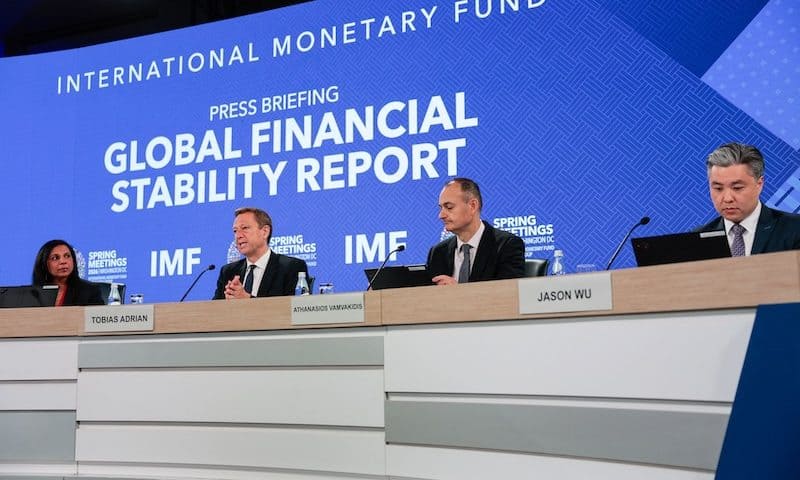
The International Monetary Fund (IMF) issued a dismal economic outlook for the month of April on Tuesday, citing concerns about rising inflation amid the war in Iran.
Economists warned that even if the conflict remains limited in duration and scope, global growth is projected to slow to 3.1 percent this year and 3.2 percent in 2027.
Countries are likely to face increased costs for energy and gas, among other resources, as international trade reflects the impact from the closure of the Strait of Hormuz.
“As in past commodity price surges, energy importers are highly exposed, with low-income developing countries— particularly those with preexisting macroeconomic vulnerabilities and limited buffers—likely to be hit hardest,” the IMF report stated.
“Gulf region energy exporters are also likely to suffer, reflecting conflict-related damage and production closures, export constraints, and weaker tourism and business activity, while countries supplying migrant workers may face remittance losses,” they added.
Nations could lose external wealth, in turn pushing up global real interest rates and further tightening global financial conditions, analysts said.
Headline inflation is expected to rise by .3 percentage points compared with last year.
“Preserving price signals is key, as they transmit a critical market signal of scarcity and of the need to reduce demand and expand supply. Price controls or export restrictions simply cannot change that fact,” economists concluded.
“Worse, they may simply push up the price of energy ex-subsidy—or create rationing in the case of price caps—providing limited relief for households and firms and generating negative spillovers to other countries, since protecting energy demand in one part of the world implies less net energy supply elsewhere,” they added.
South Asian countries particularly hard hit by the slowing of oil shipments from the Middle East have begun to adjust their energy usage and output.
Pakistan, Nepal and Sri Lanka have reduced the workweek for the public in hopes of reducing fuel usage by creating a one-day holiday, according to Reuters.
Bangladesh also banned decorative lighting at events and placed restrictions on nonessential travel while India increased production at oil refineries, per the outlet.
Pakistan is working to mediate talks between the U.S. and Iran to end the war, alongside Egypt. Last week, negotiations ended abruptly but are expected to pick back up in Islamabad later this week.
IMF economists said “global cooperation” would be needed to overcome the global challenge of the war in Iran.
“With the right policies, including a swift cessation of hostilities and the reopening of the Strait of Hormuz, the damage could remain limited,” the report said.
“International financial organizations such as the IMF were born out of a vision, forged in the aftermath of war and great destruction, to promote economic and financial cooperation and integration, to the benefit of all. More than ever, these principles are needed to preserve global prosperity,” the report concluded.