

Pfizer’s (NYSE:PFE) stock is up by 4.7% over the past three months. Given that the markets usually pay for the long-term financial health of a company, we wonder if the current momentum in the share price will keep up, given that the company’s financials don’t look very promising. In this article, we decided to focus on Pfizer’s ROE.
Return on equity or ROE is a key measure used to assess how efficiently a company’s management is utilizing the company’s capital. Put another way, it reveals the company’s success at turning shareholder investments into profits.
How To Calculate Return On Equity?
The formula for return on equity is:
Return on Equity = Net Profit (from continuing operations) ÷ Shareholders’ Equity
So, based on the above formula, the ROE for Pfizer is:
11% = US$9.8b ÷ US$93b (Based on the trailing twelve months to September 2025).
The ‘return’ is the income the business earned over the last year. Another way to think of that is that for every $1 worth of equity, the company was able to earn $0.11 in profit.
What Is The Relationship Between ROE And Earnings Growth?
We have already established that ROE serves as an efficient profit-generating gauge for a company’s future earnings. Depending on how much of these profits the company reinvests or “retains”, and how effectively it does so, we are then able to assess a company’s earnings growth potential. Generally speaking, other things being equal, firms with a high return on equity and profit retention, have a higher growth rate than firms that don’t share these attributes.
A Side By Side comparison of Pfizer’s Earnings Growth And 11% ROE
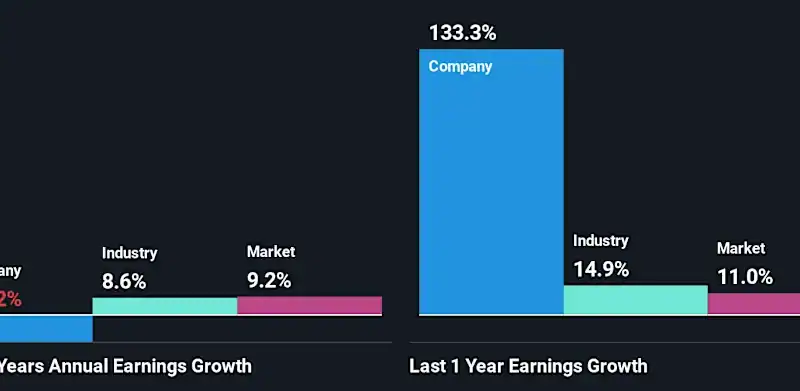
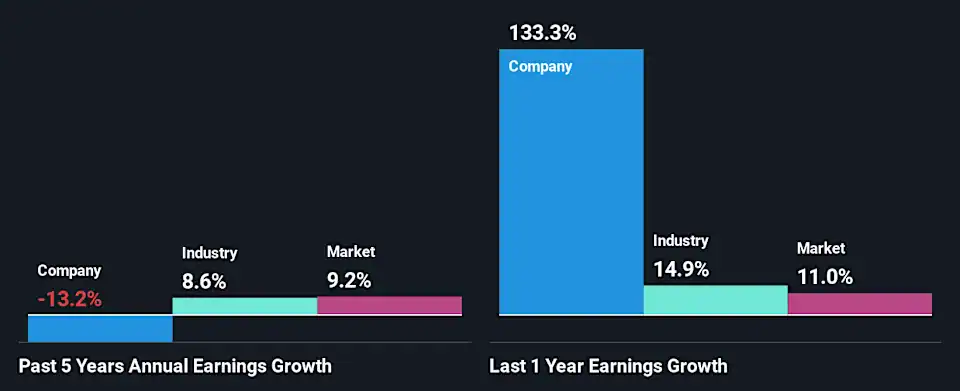
On the face of it, Pfizer’s ROE is not much to talk about. Next, when compared to the average industry ROE of 22%, the company’s ROE leaves us feeling even less enthusiastic. Therefore, it might not be wrong to say that the five year net income decline of 13% seen by Pfizer was probably the result of it having a lower ROE. We believe that there also might be other aspects that are negatively influencing the company’s earnings prospects. Such as – low earnings retention or poor allocation of capital.
That being said, we compared Pfizer’s performance with the industry and were concerned when we found that while the company has shrunk its earnings, the industry has grown its earnings at a rate of 8.6% in the same 5-year period.
Earnings growth is an important metric to consider when valuing a stock. It’s important for an investor to know whether the market has priced in the company’s expected earnings growth (or decline). By doing so, they will have an idea if the stock is headed into clear blue waters or if swampy waters await. If you’re wondering about Pfizer’s’s valuation, check out this gauge of its price-to-earnings ratio, as compared to its industry.
Is Pfizer Making Efficient Use Of Its Profits?
With a high three-year median payout ratio of 88% (implying that 12% of the profits are retained), most of Pfizer’s profits are being paid to shareholders, which explains the company’s shrinking earnings. With only very little left to reinvest into the business, growth in earnings is far from likely. You can see the 4 risks we have identified for Pfizer by visiting our risks dashboard for free on our platform here.
In addition, Pfizer has been paying dividends over a period of at least ten years suggesting that keeping up dividend payments is way more important to the management even if it comes at the cost of business growth. Existing analyst estimates suggest that the company’s future payout ratio is expected to drop to 69% over the next three years. The fact that the company’s ROE is expected to rise to 16% over the same period is explained by the drop in the payout ratio.
Conclusion
Overall, we would be extremely cautious before making any decision on Pfizer. As a result of its low ROE and lack of much reinvestment into the business, the company has seen a disappointing earnings growth rate. Having said that, we studied the latest analyst forecasts, and found that analysts are expecting the company’s earnings growth to improve slightly. This could offer some relief to the company’s existing shareholders. To know more about the latest analysts predictions for the company, check out this visualization of analyst forecasts for the company.