

Aluminum jumped after a major Middle East producer halted production and declared force majeure on shipments to customers as the escalating Iran war led to a natural gas shortage in the region.
Qatalum, jointly owned by Qatar’s state-owned aluminum producer and Norsk Hydro ASA, started a controlled shutdown of output on Tuesday and said a full restart could take six to twelve months, according to a statement. Hydro also has issued a force majeure notice to its Qatalum customers, the statement said.
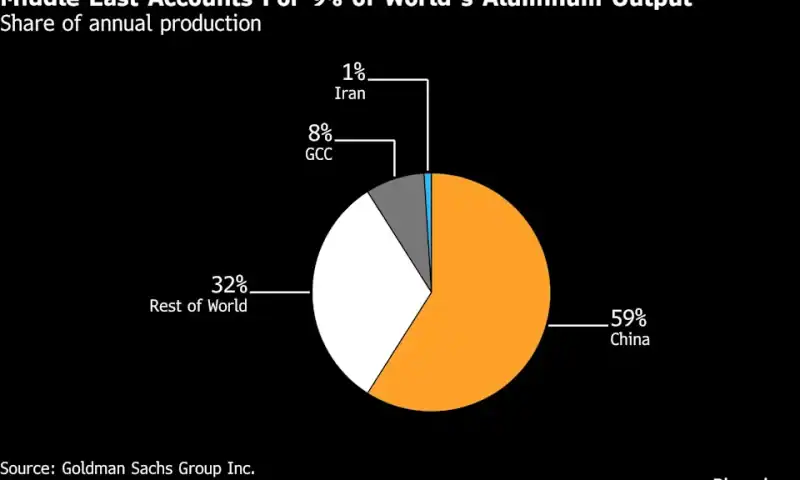
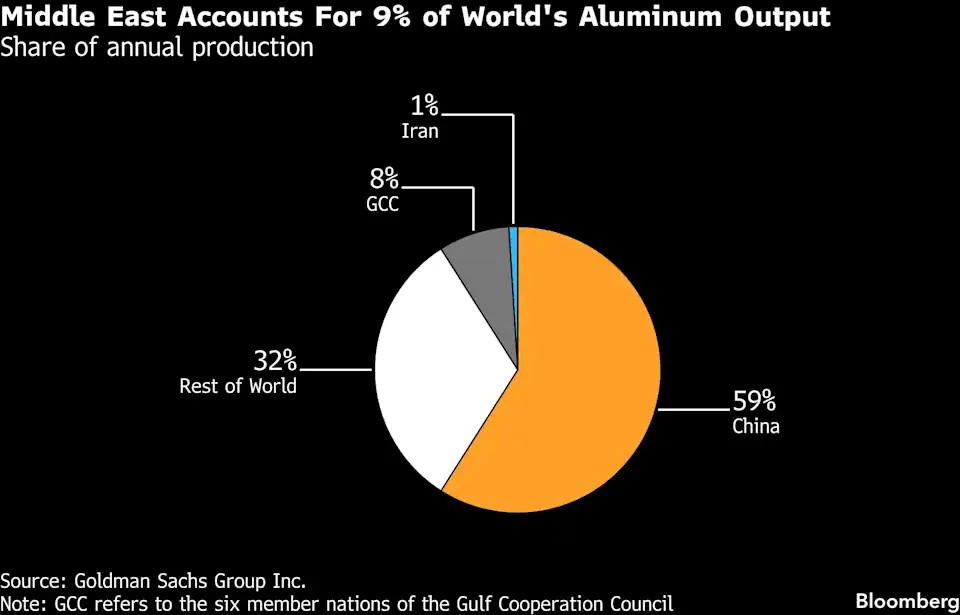
Aluminum has bucked a broader downturn in metals markets as the Middle East conflict deepens, with traders focused on potential supply dislocations or production cuts in a region responsible for about 9% of global output.
The metal surged as much as 3.8% after QatarEnergy earlier said it halted the production of aluminum and some chemicals as it grappled with the consequences of Iranian attacks that forced the shutdown of its major liquefied natural gas plant. Aluminum prices on the London Metal Exchange advanced 1.8% to settle at $3,251 a metric ton.
The conflict in the Middle East reverberated across the region as Israel bombarded Tehran with a fresh wave of strikes. The Islamic Republic fired missiles at Qatar, Bahrain and Oman, with Doha saying targets weren’t limited to military interests. Qatar and Iraq halted production at major energy sites.
Qatalum’s announcement adds to signs of growing stress for producers in the region and their customers in markets spanning Asia, Europe and the US. Orders to withdraw aluminum from warehouses tracked by London Metal Exchange more than doubled to 86,025 tons on Tuesday, as traders brace for widespread disruptions to supplies.
Emirates Global Aluminum — the UAE’s top producer — acknowledged delays to its exports and said it may draw on stockpiles outside the region to meet customer demands. Rio Tinto Group on Monday withdrew an initial offer to supply Japanese customers for second-quarter supply, as the hostilities threatened to raise regional fees.
The US Midwest premium — a key benchmark for American manufacturers — on Monday rose 1.4% to $1.055 a pound, just below the mid-February record of $1.065. Goldman Sachs Group Inc. said it sees “substantial upside” to premiums in Europe — a major market for the Gulf producers — after levels there reached the highest since 2022 last week.
But there’s also a risk that protracted hostilities could hurt major economies and fuel a downturn in metals demand.
“Pricing reflects the competing forces of short-term geopolitical risk premiums versus concerns that sustained energy inflation could weaken global industrial demand,” analysts from CreditSights wrote in an emailed note.
President Donald Trump expressed concern that the strikes against Iran could lead to a new leadership that’s equally troubling to Washington as the regime the US and Israel are fighting to topple.
Trump’s comments are likely to spur concerns about the administration’s endgame, with the conflict well into its fourth day and retaliatory actions from Iran against Saudi Arabia exacerbating fears of further escalation across the region.
The Middle East accounts for about a fifth of production outside China. Most of the metal produced in the Gulf states is exported, largely through the Strait of Hormuz that’s all but shut down as a trade route in the aftermath of the attacks. And while smelters will have stockpiles of raw materials like bauxite and alumina, production cuts may be necessary if those start to dwindle.
“Although Middle Eastern smelters may have close to one month of feedstock inventory, they may already be forced to cut production if the war drags on for around two weeks,” said Zhang Meng, an analyst with Shandong Aize Business Information Consulting Co. “They need to plan ahead, rather than waiting until all inventories are exhausted and then shutting down in a panic.”
Shipowners and insurers are already reluctant to deal with shipments to the Gulf, and many ports are closed in the region, Zhang added.
A month of fully lost production — together with spiking energy costs in Europe — could see aluminum prices shoot up to $3,600 a ton, according to Goldman Sachs. The bank’s base case is still for aluminum to average $3,150 in the first half of the year.
Aluminum buyers were already facing tight supply this year after various production curtailments and trade dislocations, and with China’s producers close to a government-imposed cap on the size of its industry. The planned mothballing of a large smelter in Mozambique has added to supply concerns in 2026, and prices are now up 22% from a year ago.
Copper fell 1.2% to settle at $12,955, while other industrial metals except aluminum declined.