

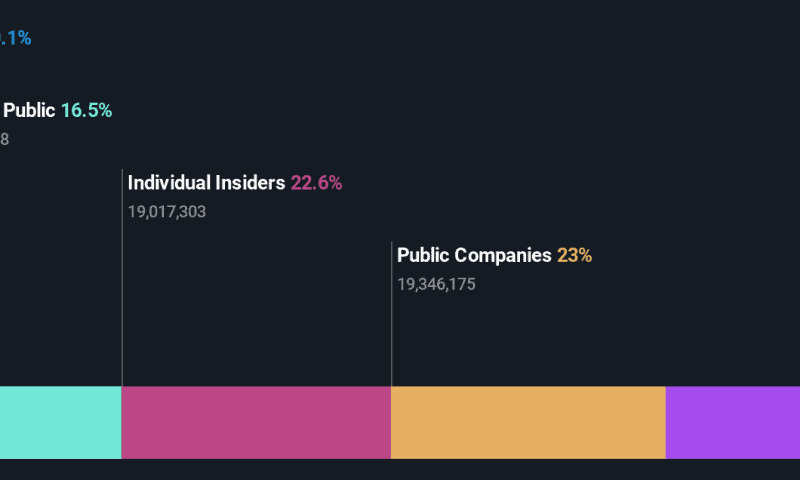
A look at the shareholders of Zhihu Inc. (NYSE:ZH) can tell us which group is most powerful. With 28% stake, institutions possess the maximum shares in the company. In other words, the group stands to gain the most (or lose the most) from their investment into the company.
Institutional investors was the group most impacted after the company’s market cap fell to US$308m last week. Still, the 9.6% one-year gains may have helped mitigate their overall losses. But they would probably be wary of future losses.
Let’s take a closer look to see what the different types of shareholders can tell us about Zhihu.
What Does The Institutional Ownership Tell Us About Zhihu?
Institutional investors commonly compare their own returns to the returns of a commonly followed index. So they generally do consider buying larger companies that are included in the relevant benchmark index.
As you can see, institutional investors have a fair amount of stake in Zhihu. This suggests some credibility amongst professional investors. But we can’t rely on that fact alone since institutions make bad investments sometimes, just like everyone does. It is not uncommon to see a big share price drop if two large institutional investors try to sell out of a stock at the same time. So it is worth checking the past earnings trajectory of Zhihu, (below). Of course, keep in mind that there are other factors to consider, too.

We note that hedge funds don’t have a meaningful investment in Zhihu. The company’s largest shareholder is Tencent Holdings Limited, with ownership of 15%. Yuan Zhou is the second largest shareholder owning 15% of common stock, and Kastle Limited holds about 10% of the company stock. Yuan Zhou, who is the second-largest shareholder, also happens to hold the title of Chief Executive Officer.
To make our study more interesting, we found that the top 5 shareholders control more than half of the company which implies that this group has considerable sway over the company’s decision-making.
Researching institutional ownership is a good way to gauge and filter a stock’s expected performance. The same can be achieved by studying analyst sentiments. Quite a few analysts cover the stock, so you could look into forecast growth quite easily.
Insider Ownership Of Zhihu
While the precise definition of an insider can be subjective, almost everyone considers board members to be insiders. The company management answer to the board and the latter should represent the interests of shareholders. Notably, sometimes top-level managers are on the board themselves.
I generally consider insider ownership to be a good thing. However, on some occasions it makes it more difficult for other shareholders to hold the board accountable for decisions.
It seems insiders own a significant proportion of Zhihu Inc.. Insiders own US$70m worth of shares in the US$308m company. This may suggest that the founders still own a lot of shares.
General Public Ownership
With a 17% ownership, the general public, mostly comprising of individual investors, have some degree of sway over Zhihu. This size of ownership, while considerable, may not be enough to change company policy if the decision is not in sync with other large shareholders.
Private Company Ownership
We can see that Private Companies own 10%, of the shares on issue. Private companies may be related parties. Sometimes insiders have an interest in a public company through a holding in a private company, rather than in their own capacity as an individual. While it’s hard to draw any broad stroke conclusions, it is worth noting as an area for further research.
Public Company Ownership
It appears to us that public companies own 23% of Zhihu. This may be a strategic interest and the two companies may have related business interests. It could be that they have de-merged. This holding is probably worth investigating further.