

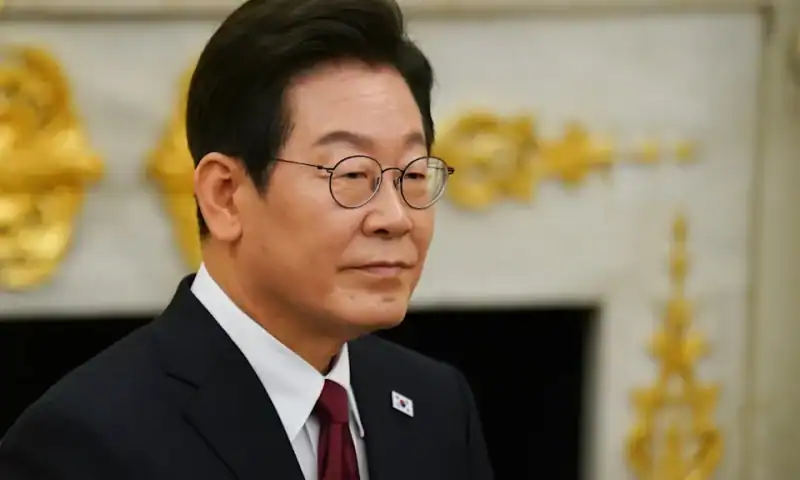
South Korean President Lee Jae Myung said a US immigration raid that led to the detention of more than 300 Korean workers has unsettled companies pouring billions into America.
“They simply needed skilled technicians to install the equipment to build the plant because there aren’t workers available in the US,” Lee said on Thursday, speaking at a press conference in Seoul to mark his 100th day in office. “This could have a significant impact on future direct investment into the US.”
Lee said the workers were dispatched on short-term stays to install equipment and got caught up in the raid amid repeated difficulties obtaining visas. He added that the raid had left him “baffled.” South Korea is now in talks with the US to resolve the visa issues, either by securing more quotas or creating a new visa category, he said.
The detainees — taken into custody last week in a raid on a Hyundai Motor Co. and LG Energy Solution Ltd. battery plant under construction in Georgia — were released from a US detention center Thursday around 1:30 a.m. local time to board a flight back home, Yonhap News said. Lee earlier said a chartered plane carrying the workers — a total of 330 people, including 316 South Koreans — is expected to arrive in South Korea Friday afternoon.
The incident has rattled South Korea, where images of shackled workers have circulated widely and fueled public anger, casting a cloud over Lee’s young presidency. It also threatens to undermine billions in investment plans by Korean conglomerates, coming just two weeks after Lee and President Donald Trump held a summit to reaffirm their economic and security ties.
Lee said the departure, which was originally planned for Wednesday, was delayed after Trump requested that the detainees be freed and given the option of staying in the US.
South Korean Foreign Minister Cho Hyun flew to Washington for a meeting with Secretary of State Marco Rubio on Wednesday and voiced his “deep concern” over the incident. Industry minister Kim Jung-kwan also departed for the US Thursday for follow-up discussions on tariffs with Washington.
The incident may inject awkwardness into another expected meeting between Lee and Trump next month. The two are likely to hold their second bilateral discussions on the sidelines of a gathering of APEC leaders in Gyeongju, South Korea that begins in late October.
The detention amplifies strains from a July trade deal that kept a 15% levy on most Korean imports. Trump has yet to sign an order lowering auto tariffs as promised, while the two sides remain divided over Seoul’s $350 billion investment pledge, a central pillar of the accord. The outcome of the standoff may determine whether Korean conglomerates press ahead with their US expansion plans or reconsider the scale of their commitments.
“We still have a long way to go in the negotiations,” Lee said. “What’s on the surface may look rough, excessive, unreasonable, even irrational, but the final conclusion will come out in a reasonable way, and we must make sure it does.”
Lee also addressed security issues on the Korean peninsula, saying peace and stability are economically crucial for South Korea. He stressed Seoul alone can’t resolve relations with North Korea, adding that resuming talks between Pyongyang and Washington is critical for the South as well.
“Right now, the most powerful influence comes from President Trump. While the role of the US itself is important, it is President Trump’s own characteristics that can contribute more directly to peace and stability on the Korean Peninsula,” Lee said. “If he can deliver tangible progress on the Korean Peninsula, the world’s last divided nation and one of the greatest sources of global instability, then he would truly deserve to be called a peacemaker.”
On the economy, Lee said South Korea’s stock market remains “heavily undervalued,” citing poor corporate governance and political upheavals as among the factors weighing on valuations.
An official proposal from July to lower the capital gains tax threshold on stock holdings to 1 billion won ($720,000) from 5 billion won raised questions about the government’s commitment to reviving the market, a core policy of Lee’s administration.
The plan, which would have expanded the pool of taxable investors, sparked a sharp selloff in Korean stocks and drew fierce opposition from retail investors. Lee said he sees no need to push ahead with the change if it risks undermining confidence in the government’s policy stance, adding that the matter will be left to the National Assembly for further discussion.
On energy policy, Lee said building additional nuclear plants is “not realistic” given the difficulty of finding suitable sites, adding that solar and wind are the fastest ways to expand power generation in the country.